I was approached by the University of Exeter, working as part of the Aspect Network of universities who were looking to develop a pre-accelerator prior to their existing ARC accelerator programme for so-called ‘SHAPE’ (Social Sciences, Humanities, and Arts) academics.
For many years I’ve supported researchers at all levels to explore how their research insights might translate into impacts beyond the academy; be that public engagement, policy change, licensed IP, start-ups, spin-outs, or myriad other forms. I firmly believe this is not just about exploiting the potential of good ideas, but also valuable personal and professional development for academic colleagues who can really benefit from the associated skills, networks, and associated resources.
The team from Exeter had a model for a series of short online workshops, staged over 3-4 months, through which a cohort of academics with interesting ideas would be supported to explore the options for commercialising their ideas. I should stress that ‘commercialise’ in this context includes not-for-profits that are nonetheless economically sustainable.
In liaison with the Research and Innovation team I designed and now deliver four elements of the five-part Entrepreneurial Researcher Programme offering:
- Understanding Our Audiences
- Designing for Impact
- Creating Sustainable Impact
- Final Presentations
Content Breakdown
The ambition for the Entrepreneurial Researcher workshops was to create an engaging series of interactive workshops that provided accessible tools, timely provocations, and expert advice on how best to to explore their ideas.
I used methods and tools drawn from User Research, Design Thinking, Systems Thinking, and Entrepreneurial Venture Creation throughout the workshops, including:
- Empathy and Journey Mapping
- Systems Maps
- Ideation and Creative Thinking
- Value Proposition Design
- ‘Elements of Value’
- Business Model Canvas
- Lean Startup
- Prototyping
The most transformative elements are typically breaking down different stakeholders (beneficiaries, users, and customers) and how they all require different value propositions and embracing the idea of ‘fast failure’ through using principles of Lean Startup and Prototyping so valuable time is not wasted as academics are typically already very busy.
A Formula for Change
One content element that seems to have proved really valuable as a means of helping participants develop their ideas and win over stakeholders has been the ‘Formula for Change’
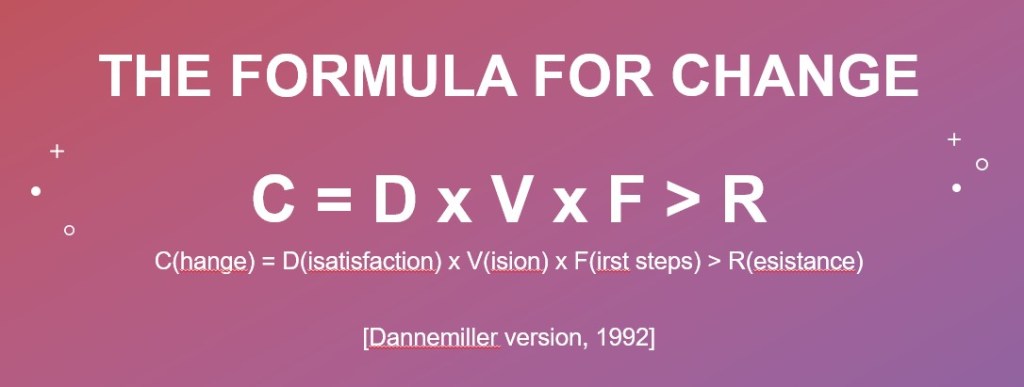
The formula offers 3 ‘levers’ that can be utilised to overcome resistance to change:
- D(issatisfaction) – people are more likely to take action if the problem is pressing; how can you make the scale or impact of the problem more apparent?
- V(ision) – people are more likely to take action if they see a positive opportunity for themselves or others; can you create or make more obvious the opportunities that emerge if change is made?
- F(irst steps) – people are more likely to take action if the initial steps are low-cost (money, time, effort, reputation) so how might you make your change easier and less costly to adopt?
Some combination of these levers is available to any change project and thinking them through from the perspective of your various stakeholders (beneficiaries, users, customers) can transform your approach.
Response to the work
Delivery has been really well received so far and we have gone from that single initial cohort to initiating our 4th and 5th cohorts in the first months of 2023!
- Over 24 institutions have now had academic participants on the programme
- Our overall feedback score is 9.5/10
- Feedback from Exeter University suggests more than 87% of participants have gone on to further commercialisation and impact activities.
- 100% of participants expressed that they had ‘confidence in taking the next steps for their project’
Overall, this programme delivered a lot of value for me. I think that was especially down to the excellent materials and curation supplied by Dave Jarman.
Participating Academic
I really enjoyed the sessions and learned a lot. I liked the fact they were interactive and we got to ask questions and present our ideas. The speakers were very knowledgeable and drew on their experience regularly which really facilitated their points.
Participating Academic
The pre-accelerator programme really focused our minds on how we were presenting our value proposition, how we were communicating our ideas, and who we were presenting it to. It broadened who we conceived of as our stakeholders significantly, we began to include non-primary stakeholders who ended up as our primary collaborators. It also gave me the impetus to speak to stakeholders, not waiting until we were ready but just going and talking to them now. I fully recommend this programme as a way to move your project/research/plan forward in new, exciting and manageable ways.
Participating Academic
Dave is one of the most responsive, insightful and engaging facilitators we have worked with. He combines both an understanding of the academic sphere and how to work with research ideas to encourage the translation for a commercial element. Dave works with myself and others closely to understand the key aims of this platform that allows for ideas to be fully explored and tested in a safe space. He has engendered an environment that gives academic confidence in entrepreneurial thinking, which means it can be applied to many contexts. Dave is a key element to the programme’s success.
James Woodhams – Commercialisation Manager for CRoSS (University of Exeter)
 Dave Jarman
3 thoughts on “Case Study: The Entrepreneurial Researcher: Supporting Arts and Social Science researchers to generate impacts from their research. Ongoing since Spring 2022.”