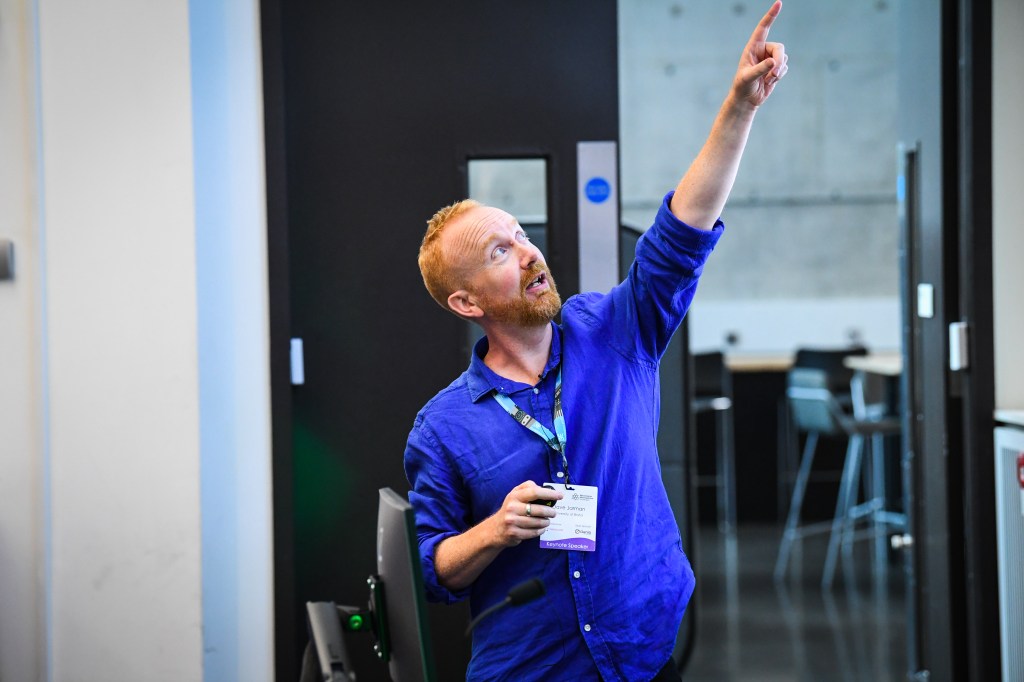
On the 11th September I had the honour of keynoting the 19th International Enterprise Educators Conference (IEEC) at Manchester Metropolitan University.
My slides are below, but short and long versions of my narration follow.
Shortest Version
Puppies are disruptive. This is Blossom.

Short Version
We’re surrounded by disruptions, some are catastrophic derailments of our ambitions, plans, and routines (see Blossom, above); some are merely speedbumps, some turn out to be better routes than we’d initially envisaged (see Blossom, above).
Our students are growing up amid a polycrisis (environmental destruction, social splintering, upheavals to work caused by automation…) and what they don’t need any more is knowledge-based lecturing because they have access to huge quantities of high-quality sources and synthesis – what they need is far more human; I call it ‘actionable hope’ – the frameworks to understand all this turbulence, the tools and methods to take action, and human contact and insight (or wisdom) over time to find resonance with what matters to them so they can work towards the futures they desire and avoid adding to the negative consequences of ill-considered actions.
Students in a crisis often seek simple recipe-type answers which are not available. How do we judge an appropriate level of ‘constructive friction’ to detour (but not derail) them through the complexity in our classrooms to find potential solutions?
Universities cannot just teach ‘bare facts’, we need to offer imaginative possibilities, provide a space to evaluate and decide which futures we want and share the means to achieve them in the teeth of disruption.
Longer Version
After 17 years in Enterprise Education working in Students’ Unions, Careers Services, Research & Enterprise Functions, Academic Teaching, and freelancing in Research Commercialisation and Impact I’ve got some insights. Some are rooted in deep experience, some are ‘hot takes’ based on conversations and insights from my network.
Disruption is constant, but your reaction to it frames it; is it a catastrophe, a total derailment of your hopes and ambitions? Is it a speedbump or detour that still ends where you expected? Or is it an opportunity, a ‘creative destruction’ of something that was holding you back from something better? I likened this to getting a new puppy – yes, they’ll destroy your house, furnishings, garden, sleep, routines… but new routines emerge, you adjust, and you gain a wonderful companion.
I talked about how Enterprise Education (and adjacent causes like Employability in HE) have changed over my career; from being radical, ‘fringe’, elements to being central to many HE’s visions and missions. But that shift to the mainstream is not without the challenges of scale, from being ‘artisans in the workshop’ scrapping it out with little resource but low stakes and oversight, to being ‘technicians on a production line’ where resources are competed over by internal factions, where maverick approaches are either unscalable to larger classrooms or perceived as risks to programme consistency. We dilute something of what we taught to small groups when we teach to huge theatres to be able to reach *everyone* in the market.
I wondered if we had, or would lose, something of our own entrepreneurialism through scale. We know this happens in start-ups as they scale, founders are not always the right people to lead scaled-up companies. We have to acknowledge this happens to us as entrepreneurial educators too, we might need to change. We’ve gone from being the disruptors to being disrupted.
A planned but fogotten theme on the day was the risk of burnout; most enterprise education people I know are resourceful, engaged, enthusiastic generalists – we make ourselves valuable and useful in our organisations (despite our rough edges) – and our institutions come to rely on that to get stuff done. But as previous IEEC keynote Martin Lackeus reminded me earlier this year “legal institutions will not love you back” and we can find ourselves worn out.
I mentioned Musk’s trajectory over time; he was briefly an entrepreneurial hero, he transformed EVs, he was taking us to space. But now he’s actively destroying the fabric of society. But it’s the same disruptive spirit, he’s just moved to the things we didn’t want him to disrupt. Musk is also an interesting case study in that a particular upbringing created a relentlessly disruptive character. Similar ‘tough’ early experiences and upbringings have been observed in elite athletes and other high-achievers, so adversity clearly plays a role in our development – but how much is useful character-building ‘friction’ and how much is ‘trauma’?
I tried to identify some ‘weak signals’ from the future:
- EntEd is largely now embracing ‘sustainability’ as a requirement (here in the UK anyway). We’re already seeing this develop further towards ‘restorative’ and ‘regenerative’ forms of entrepreneurial activity. This is a good thing.
- But we’re also getting push-back from students on this agenda; ranging from “the environmental crisis isn’t my fault, why do I have to solve grandad’s mistakes?” to “I need to earn money first, then I’ll fix the planet.”
- Many students don’t embrace the title ‘entrepreneur’, in some part due to themes related to Musk. They DO buy into many of the methods and mindsets we teach, but they’re wary about the self-identification with that Silicon Valley “break things” culture. We need a more diversified vision of who and what entrepreneurs are if we’re too win more converts to our approaches.
- If EntEd ‘mainstreamed’ all the way to becoming mandatory (a bit like Employability) what would that mean? We don’t have the specialists to do that well so will we be co-opting other academics or relying on AI to do that? Inevitably, some ‘bits’ of EntEd would make it into a mandatory exposure for all students – but which bits?
I also offered some thoughts on AI. If students are using it to write their work, and we’re using it to mark the work, can’t we all just go home for a lie down? More seriously, if students have got all the world’s knowledge at their fingertips and the means to summarise it, what’s our job now? My answer is twofold – it’s providing context and ‘constructive friction’– we need to offer insight and nuance to how and when to use that knowledge (and when not to), and we need to offer challenges and critiques to their ideas and ambitions because the evidence suggests that without cognitively wrestling with all this knowledge it won’t become experience.
AI has made it very easy to make things, to generate things, but are they the right things? AI has been offered to us, sometimes rather aggressively, but we never asked for it and we’re not entirely happy about all losing our jobs to it. I think this cues up a valuable conversation with students about what we want the future to look like and how that should drive innovation rather than Silicon Valley foisting stuff on us, capitalising the gains and socialising the costs.
“The value of education must lie not only in its ability to equip people to earn money, but to make a world that is worth living in.” Danny Sriskandarajah, 2024
I drew on Bill Sharpe’s 3 Horizons model to discuss how our work helps students navigate the space between Horizon 1 (Business as Usual) and Horizon 3 (Far-off Futures) by using the entrepreneurial transition of Horizon 2 ideas. This is an uncertain space in which ideas which could be stepping-stones to the future sometimes get captured by the status quo to preserve today’s model.
The role of Enterprise Educators is to ‘midwife the future’ – to help our students navigate that space between today’s assumptions and tomorrow’s better ideas. Central to this is the role of Hope.
“Hope is not the same as optimism… optimism is a largely passive assumption… hope is different; it is the belief that things can change for the better, and the resolve to work towards that change.” Danny Sriskandarajah, 2024
My contention is that Enterprise Education is uniquely placed to offer our students the ways, means, and resolve to drive change.
By teaching systems thinking, design thinking, futures and foresight we are helping students understand their contexts so that they can find places to gain leverage and consider taking effective action.
By teaching effectuation, creative problem-solving, and lean start-up we are providing the tools to take that effective action, to bounce back from failing, and to iterate their ideas into more effective forms.
Finally, by allowing students to work on their own ideas and causes, by supporting them through that process, and by challenging them to reflect on what they’ve done and what they could do, we’re creating resonant, motivating, education that provides autonomy, mastery, and purpose.
My takeaways:
- Ask “what does good look like?” about any prospective project or venture. It helps understand the system, the consequences, the motivations. It teases out unforeseen consequences and parameters.
- Embrace disruption with Robert Poynton’s improvisational principle that “Everything is an Offer”. You may not be initially grateful for that offer, but it’s up to you to make the most of it. Which leads me to:
- Experience + Reaction = Outcome. However good or bad your experiences it’s what you do next that really shifts the result, regardless of what you were dealt.
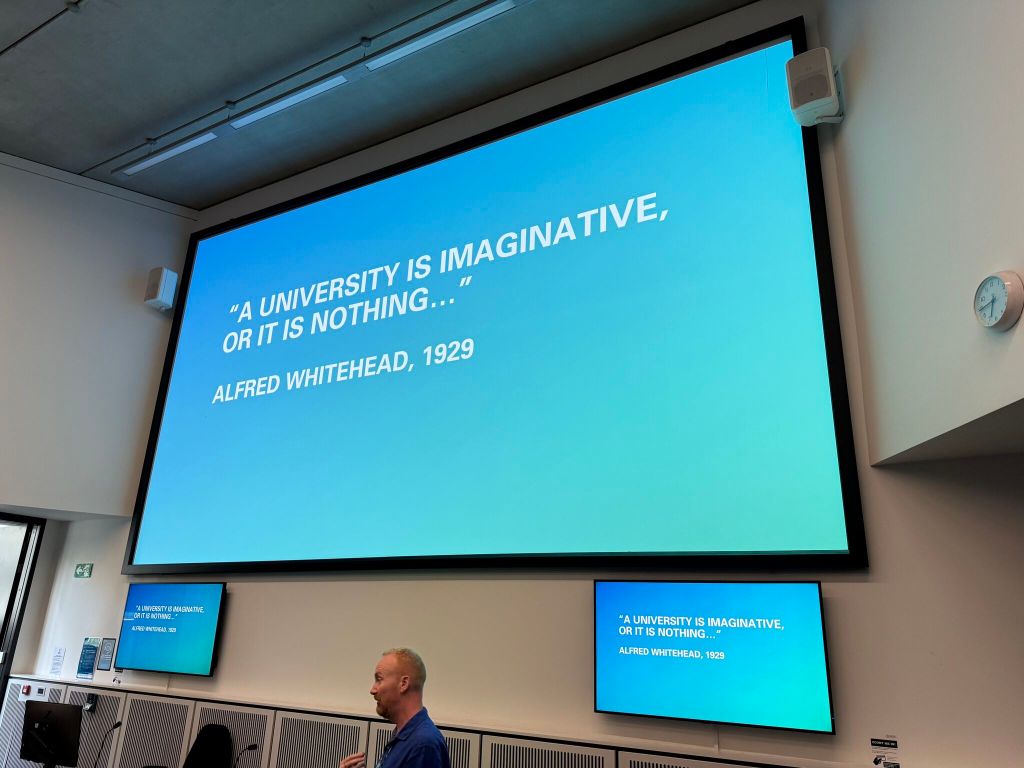
Whilst Universities in the UK are going through huge turbulence right now, we should not forget what they are for. They were never about serving up ‘bare facts’ they were always about possibility.
“A university is imaginative, or it is nothing…”
Alfred whitehead, 1929
 Dave Jarman